Name and Describe the Four Types of Membranes That Can Be Found Lining the Body Cavities.
B y O.P. (Paul) Gobée, dept. of Beefcake and Embryology, Leiden University Medical Centre, concluding update: 17 february 2018
Serous membranes
The pleura, pericardium and peritoneum are serous membranes. This department explains the terms 'serous membrane', 'serosa', 'mesothelium', which are often used in shut relation with each other.
Serous membranes are membranes lining airtight internal body cavities. The pleura, pericardium and peritoneum are serous membranes that line respectively the pleural, pericardial and peritoneal cavities.
Serous membranes secrete a slight amount of lubricating fluid. This allows the layers of the pleura, pericardium and peritoneum to motility in relation to each other, and hence provides a sure amount of mobility to the ensheathed organs (resp. lung, heart, intestine). The secreted fluid is called serous fluid. A serous fluid is a watery fluid, resembling (blood-)serum. This also explains the name 'serous membrane'.
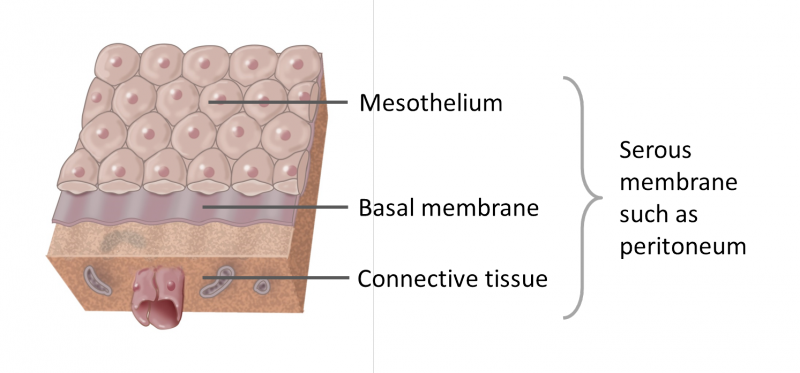
Figure. Histology of a serous membrane
Serous membranes consist of a single layer of epithelium, named mesothelium, fastened to a supporting layer of connective tissue, with a small layer in betwixt, the basal membrane (fig i).
Epithelia are covering tissues. The blazon of epithelium that lines the internal body cavities, is called mesothelium. It is the mesothelium that secretes the lubricating fluid.
The largest function of the gut tube is ensheathed in peritoneum. Histologically, this can be seen every bit a layer on the outside of the gut. In histology this layer is called serosa afterward serous membrane. Serosa thus is the same as visceral peritoneum.
Source: https://anatomytool.org/content/serous-membranes
0 Response to "Name and Describe the Four Types of Membranes That Can Be Found Lining the Body Cavities."
Post a Comment